This post may contain affiliate links. As an Amazon Associate, I earn from qualifying purchases.
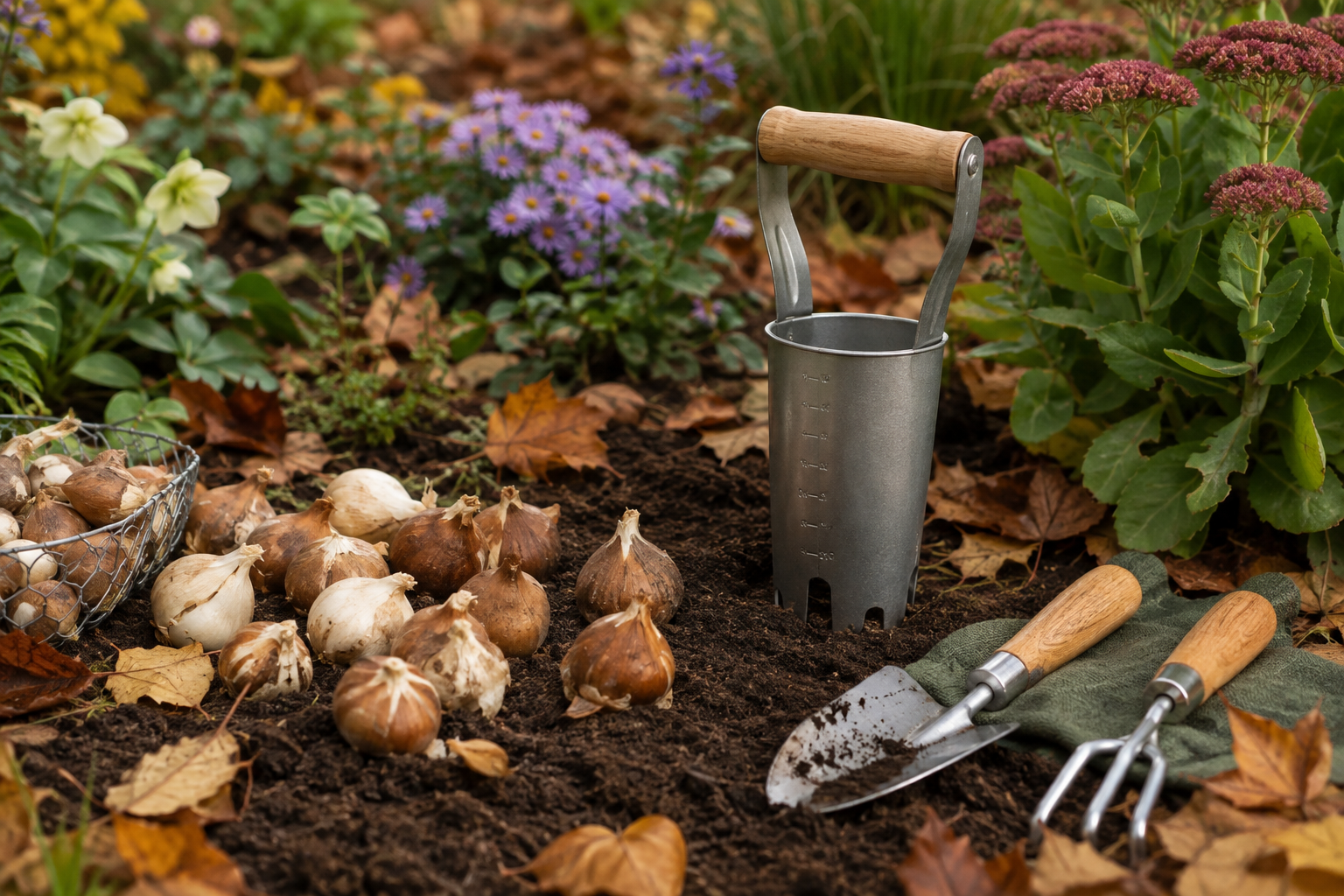
Planting spring bulbs is one of the most satisfying jobs in the fall garden. A few hours spent setting tulips, daffodils, crocuses and alliums into the soil can turn into weeks of color the following spring.
The repetitive digging is the part that can make the job feel much harder than it needs to be. A small handheld bulb planter may be perfect for tucking a dozen bulbs between established perennials, while a long-handled planter can reduce repeated kneeling. If you are planting dozens of bulbs across a larger bed, a drill-powered auger can make the work considerably faster.
For this updated guide, we screened seven bulb planters with clearly different strengths rather than filling the list with near-duplicates. We looked at construction, planting style, review history, availability, return-risk signals and whether each tool solves a genuinely different problem.
If you are planting bulbs in containers rather than open ground, start with our guide to planting spring bulbs in pots. You may also like Tendrelia’s 11 Best Spring Bulbs for a Cottage Garden and our Fall Cottage Garden Checklist.
Our Top Bulb Planter Picks
| Pick | Product | Best for | Tool style |
|---|---|---|---|
| Best Overall | Haliaeetus 6-Inch Bulb Planter | Precise manual planting with deeper markings | Handheld planter |
| Best Long-Handled | Colwelt 37-Inch Long Handle Bulb Planter | Planting from a standing position | Long-handled planter |
| Best Traditional Handheld | Berry&Bird 4-Inch Bulb Planter | Simple, sturdy planting in smaller borders | Handheld planter |
| Best Drill Auger | Power Planter 3" × 7" Auger | Fast repetitive bulb holes | Drill auger |
| Best for Planting Lots of Bulbs | NAFOGAR 2-Piece Auger Set | High-volume planting with two hole sizes | Long drill-auger set |
| Best Extended-Length Auger | Power Planter 3" × 24" Extended Auger | Extra reach with less bending | Extended drill auger |
| Best Budget | Garden Guru Eco Bulb Planter | Affordable occasional bulb planting | Handheld planter |
Prices, coupons and availability can change. Check the Amazon listing for current details before buying.

How We Chose These Bulb Planters
Bulb planters are simple tools, but small differences in design can matter once you start making hole after hole. We screened these picks for practical usefulness rather than choosing seven products that all do the same thing.
- Construction: we looked for steel bodies, sturdy shafts, reliable handles and working edges that are appropriate for garden soil.
- Planting comfort: some gardeners want close handheld control, while others need a tool that reduces bending or repetitive twisting.
- Depth and hole size: a planter has to match the bulbs you actually grow.
- Review history: we checked not only headline ratings but also recurring praise and complaints about bending, stability, soil release and durability.
- Availability and purchase quality: we prioritized normal Amazon U.S. purchase flow, current stock and products without a visible “Frequently Returned Item” warning at the time of screening.
- Useful differentiation: every product below has a distinct reason to be included.
We also rejected a heavy-duty auger candidate after its low-star reviews raised concerns about machining, shaft straightness and suitability for compacted soil. A longer list is not useful if weaker products are included simply to fill space.
1. Haliaeetus 6-Inch Bulb Planter — Best Overall
The Haliaeetus 6-Inch Bulb Planter is our Best Overall pick because it combines a sturdy traditional design with unusually useful depth guidance. Its planting cylinder is marked from roughly 1 to 6 inches, making it easier to keep holes consistent when you are moving between smaller bulbs and deeper-planted tulips or daffodils.
The stainless-steel body has a serrated lower edge to help bite into the soil, while the broad wooden handle gives you a stable grip for the push-and-twist motion. During our screening, customer feedback repeatedly emphasized sturdy construction, a substantial feel and effective cutting through ordinary garden soil. That gives it more confidence-inspiring construction than many lightweight handheld planters.
- Why we like it: the 6-inch depth scale is genuinely useful for spring bulbs.
- Construction: stainless-steel planting body with a wooden handle and serrated cutting edge.
- Best for: gardeners who want one manual planter for precise holes without adding a drill to the job.
- Standout feature: deeper markings than many compact handheld bulb planters.
Consider before buying: it is still a handheld tool. If you are planting a very large drift, repeated bending or kneeling may become tiring. For long sessions, pair a handheld planter with a comfortable kneeling setup or consider one of the standing or drill-powered options below.
Check the Haliaeetus 6-Inch Bulb Planter on Amazon
2. Colwelt 37-Inch Long Handle Bulb Planter — Best Long-Handled
The Colwelt 37-Inch Long Handle Bulb Planter is the option for gardeners who want to stay more upright. Instead of kneeling for every hole, you position the serrated cylinder, use the foot pedal to drive it into workable soil, twist, then lift the plug out.
The tool has a soft-grip T-handle and a two-pedal design intended to give you both downward leverage and a way to release the soil plug. Its approximately 3½-inch cutting diameter is wider than many compact hand planters, which can be useful for larger bulbs or small planting pockets.
- Why we like it: 37-inch handle reduces repeated kneeling.
- Leverage: foot-assisted design helps drive the cutter into normal garden soil.
- Best for: repeated planting where comfort and an upright working position matter.
- Useful extra: the same tool can also function as a small sod plugger.
Consider before buying: the product information we reviewed describes a maximum hole depth of roughly 4.7 inches. That can be too shallow for some large tulips and daffodils, depending on the bulb and local planting guidance. Use it where the depth suits your bulbs, or deepen the hole with another tool when necessary.
If reducing strain matters to you, you may also want to compare our best garden kneelers and seats for other low-to-the-ground garden jobs.
Check the Colwelt Long Handle Bulb Planter on Amazon
3. Berry&Bird 4-Inch Bulb Planter — Best Traditional Handheld
The Berry&Bird 4-Inch Bulb Planter is a good fit for gardeners who prefer a classic manual tool with a simple wooden handle and stainless-steel planting body. It is compact enough to work between established perennials, around the front of borders and in smaller planting pockets where a long handle or wide auger can feel awkward.
The planting cylinder includes depth markings up to 4 inches. During our review screening, buyers frequently praised the tool’s sturdiness and hole size, and some specifically reported success in heavier soil. That makes it a reassuring option for a straightforward handheld planter.
- Why we like it: simple, sturdy design with no complicated mechanism.
- Depth guidance: markings help keep shallower planting holes consistent.
- Best for: smaller borders, precise planting and gardeners who prefer manual control.
- Construction: stainless-steel body with a short wooden handle.
Consider before buying: customer feedback on soil release is mixed. In sticky ground, the soil plug may not always fall out cleanly. It is also a 4-inch-depth tool, so it is not the best choice when your bulbs require substantially deeper planting.
Check the Berry&Bird Bulb Planter on Amazon
4. Power Planter 3" × 7" Bulb & Bedding Auger — Best Drill Auger
When speed matters, the Power Planter 3" × 7" Bulb & Bedding Auger is the strongest compact drill-powered option in this guide. The 3-inch cutting diameter is well suited to many individual bulb holes, while the short 7-inch body is easier to control than a very long auger.
It uses a 3/8-inch non-slip hex drive and an alloy-steel construction. Power Planter positions this size specifically for bulbs and bedding plants, and the customer feedback we reviewed strongly favored its speed, ease of use and digging performance. Some users reported getting through large bulb-planting sessions much faster than with a hand tool.
- Why we like it: compact size offers a good balance of speed and control.
- Hole size: 3-inch diameter suits many tulip, daffodil and bedding-plant holes.
- Best for: gardeners who already own a suitable drill and want to speed up repetitive planting.
- Brand advantage: Power Planter specializes in garden augers rather than treating the product as a generic accessory.
Consider before buying: you need a compatible drill, and powered digging requires more awareness than a hand planter. Work at a controlled speed and avoid known roots, irrigation lines, low-voltage cables and buried services. Follow the manufacturer’s drill guidance rather than using an impact driver unless the specific model explicitly allows it.
Check the Power Planter 3" × 7" Auger on Amazon
5. NAFOGAR 2-Piece Auger Set — Best for Planting Lots of Bulbs
The NAFOGAR 2-Piece Auger Set earns its place because it gives you two useful hole sizes in one kit: a narrow 1.6" × 16.5" auger and a wider 3.5" × 16" auger. That combination makes sense when you are planting a mixture of smaller and larger bulbs rather than repeating the same hole size across an entire bed.
The longer shafts can also reduce how far you have to bend compared with a short drill auger. During our screening, customer feedback was strong on overall quality, speed and versatility, including reports of good performance with battery-operated drills and in clay soil.
- Why we like it: two diameters make the set more versatile for mixed bulb sizes.
- Reach: 16-inch-plus shafts keep the drill farther from the soil surface.
- Best for: larger planting sessions where you want speed and different hole sizes.
- Compatibility: designed around a standard 3/8-inch hex-drive setup.
Consider before buying: feedback on stability is somewhat mixed. Wider augers can produce more torque, particularly in dense ground, so use a firm two-handed grip on the drill and do not force the tool if it catches on stones or roots.
Check the NAFOGAR 2-Piece Auger Set on Amazon
6. Power Planter 3" × 24" Extended Auger — Best Extended-Length Auger
For gardeners who want more reach and less bending, the Power Planter 3" × 24" Extended Length Garden Auger is the longest option in this guide. The extended shaft keeps the drill farther from the soil, while the 3-inch cutting diameter stays practical for bulbs rather than moving into oversized post-hole territory.
The model uses alloy steel, a black-oxide finish, a 1/2-inch non-slip hex drive and heavy 10-gauge spiral flighting. Customer feedback we reviewed included reports of successful use in clay and around small stones or pebbles, alongside strong comments on durability and functionality. However, Power Planter also sells a separate Heavy Duty configuration for consistently hard clay or rocky ground, so we would not treat this standard extended model as a dedicated hard-soil tool.
- Why we like it: the long shaft makes it easier to reach the soil without as much bending.
- Reach: 24-inch length keeps the drill farther from the ground.
- Best for: gardeners who want extra reach and a more substantial auger than a compact bulb bit.
- Drive: 1/2-inch hex requires a drill with the appropriate chuck and enough power for the job.
Consider before buying: this is not the lightest or simplest option. Some buyers report that stability depends on how securely the bit is held in the drill chuck. Tighten the chuck properly, use an adequately powered drill and stop if the auger binds rather than forcing it through a major obstruction.
Check the Power Planter 3" × 24" Extended Auger on Amazon
7. Garden Guru Eco Bulb Planter — Best Budget
The Garden Guru Eco Bulb Planter is our budget pick because it keeps the design simple without looking disposable. It uses a stainless-steel planting body, an ergonomic wooden handle and depth markings for more consistent planting.
The manufacturer also emphasizes the use of 100% recycled stainless steel and FSC-certified wood. Those details are not essential to making a planting hole, but they are a welcome extra in a low-cost hand tool. The customer feedback we screened was strongly positive on functionality and ease of use, including specific praise for fall-bulb planting.
- Why we like it: affordable price with a proper stainless-steel and wooden-handle construction.
- Best for: occasional bulb planting and gardeners who do not need a powered or long-handled tool.
- Useful extra: depth markings help with consistent planting.
- Eco detail: recycled stainless steel and FSC-certified wood.
Consider before buying: its review history is smaller than several of the products above, and it is still a handheld planter that requires bending or kneeling. For large planting projects, the long-handled or auger options will usually save more time.
Check the Garden Guru Eco Bulb Planter on Amazon
Handheld vs. Long-Handled vs. Drill Auger: Which Is Best?
Choose a handheld bulb planter for precision
Handheld planters work especially well in established cottage borders where you are fitting bulbs between perennials, edging plants and existing roots. You can see exactly where the cutting edge is going, and the short tool gives you more control than a long shaft.
The trade-off is posture. If you are planting dozens of bulbs, repeated kneeling or crouching can become the hardest part of the job.
Choose a long-handled planter to reduce bending
A standing planter makes sense when you want the simplicity of a manual tool without getting down to soil level for every hole. Foot leverage can also help in normal garden soil. The key limitation is depth: some long-handled plug-style tools do not cut deeply enough for every large spring bulb.
Choose a drill auger for speed
Drill augers are the obvious choice when you have a lot of individual holes to make and already own the right drill. Short augers are easier to control, while long or heavy-duty augers reduce bending and can handle more demanding work.
Powered digging also requires more caution. An auger can catch on a root or stone, and a wide bit can transfer substantial torque back through the drill. Start slowly, keep a firm grip and stop rather than forcing the bit through an obstruction.
What Size Bulb Planter Do You Need?
The right hole depends on the bulb. Small crocuses and grape hyacinths need far less space than large tulip or daffodil bulbs. A narrow hand planter or small auger is useful for small bulbs, while a 3-inch or wider cutter gives larger bulbs more room.
Depth matters just as much as width. Always follow the instructions supplied with your bulbs because recommendations vary by species, bulb size and growing conditions. As a general reference, many tulips are planted around 5 to 7 inches deep, daffodils around 6 to 7 inches, and smaller bulbs such as crocuses and grape hyacinths around 3 to 4 inches. A broader rule is to plant many bulbs at roughly two to three times the bulb’s height, but the supplier’s instructions should come first.

That is why a 4-inch planter can be excellent for some bulbs but unsuitable as the only tool for deeply planted large bulbs. A tool should fit the planting instructions, not the other way around.
Which Bulb Planter Is Best for Clay Soil?
Clay changes the job. When it is very wet, it can stick inside a cylindrical planter. When it is dry, it can become hard enough to make lightweight tools frustrating to use.
For consistently hard clay or rocky ground, prioritize a model that the manufacturer specifically rates for heavy-duty use. Some buyers report good results with the standard Power Planter 3" × 24" in clay, but Power Planter also offers a separate Heavy Duty configuration designed for more demanding soil. The compact Power Planter 3" × 7" remains a better choice when you want more control and do not need the extended reach.
Even with a strong tool, soil moisture matters. If clay is baked hard, watering the area and allowing it to drain before planting can make the job easier. Do not use a drill auger to force your way through large stones or major roots.
Is a Bulb Planter Better Than a Trowel?
Not always. If you are planting only a handful of bulbs in loose soil, a sturdy garden trowel may be all you need.
A dedicated planter becomes more useful when you want repeated holes of a similar width and depth, when you are planting a larger number of bulbs, or when you want to reduce bending. An auger adds speed, while a manual planter gives you more precision around established plants.
For broad naturalized drifts, another method can be faster: loosen or lift a larger section of soil, arrange several bulbs together, then backfill the entire area. Cottage gardens often look more natural when bulbs appear in informal groups rather than perfectly spaced rows.

What to Look for When Buying a Bulb Planter
1. Cutting-edge strength
A thin cylinder may work in loose potting mix but deform in established garden soil. Look for a sturdy steel body, a serrated working edge or a purpose-built auger flighting appropriate to the way you garden.
2. Planting depth
A convenient tool is not useful if it cannot reach the depth your bulbs require. Compare the planter’s working depth with the planting instructions on the bulb packet before buying.
3. Your soil type
Loose loam is forgiving. Sticky clay, dry compacted soil, gravelly beds and root-filled borders are harder on tools. If your ground is difficult, prioritize strength and control over clever mechanisms.
4. How many bulbs you plant
For ten bulbs, a simple handheld planter may be perfect. For a hundred bulbs, a standing tool or drill auger can change the entire experience. Buy for the scale of the job you actually do.
5. Drill compatibility
Do not assume every auger fits every drill. Check the shank size, chuck capacity and manufacturer power recommendation before ordering. A heavy 1/2-inch-drive auger is a different tool from a compact 3/8-inch garden bit.
Frequently Asked Questions
Are bulb planters worth buying?
They can be, especially if you plant bulbs every fall or make many individual holes. A dedicated planter can improve consistency, and long-handled or drill-powered models can reduce repetitive effort. For only a few bulbs, a good trowel may be enough.
What is the best bulb planter for tulips?
Choose a tool that can make a hole wide enough for the bulb and deep enough for the planting instructions supplied with your tulips. The Haliaeetus handheld planter offers depth markings up to 6 inches, while a drill auger can be useful when planting many tulips across a larger area.
What is the best bulb planter for daffodils?
Large daffodil bulbs usually need more depth than a shallow hand planter can provide, so check the bulb supplier’s guidance first. A deeper handheld planter or suitably sized auger is often more flexible than a shallow plug-style tool.
Can you use a drill auger in clay soil?
Yes, if the auger and drill are built for the job and the clay is not baked extremely hard. Heavy-duty augers can work well in clay, but use controlled speed and stop if the bit catches on a stone or root. Very wet clay can also stick to the flighting.
Is a long-handled bulb planter better for your back?
It can reduce repeated kneeling because you work from a more upright position. However, you still apply downward pressure and twisting force, so choose a tool that suits your strength and soil conditions.
Can a bulb planter be used for small plants?
Some wider planters and augers can make holes for small bedding plants or transplants, but only when the root ball fits the diameter and the manufacturer supports that use. Do not force a plant into a hole that is too narrow.
Which Bulb Planter Should You Choose?
For an all-around manual tool, the Haliaeetus 6-Inch Bulb Planter gives you useful depth guidance and sturdy handheld control. Choose the Colwelt 37-Inch when reducing repeated kneeling matters most, or the Berry&Bird when you prefer a simple traditional hand tool.
If speed is the priority, the compact Power Planter 3" × 7" is our favorite drill auger, while the NAFOGAR 2-Piece Set is more versatile for planting many bulbs of different sizes. For extra reach and less bending, the Power Planter 3" × 24" is our extended-length choice. And if you simply want an inexpensive planter for occasional fall planting, the Garden Guru Eco Bulb Planter keeps the cost low.
Whichever style you choose, match the tool to your bulb size, planting depth and soil rather than buying on convenience alone. A good planter should make fall planting easier without sacrificing the conditions your bulbs need for a beautiful spring display.
For more essential equipment, see Tendrelia’s 9 Best Garden Tools for Cottage Garden Beginners.
Responses
[…] bulbs, pair a stable kneeling surface with the right digging tool. Our guide to the best bulb planters explains which styles work for small borders, larger displays and repetitive […]
[…] Daffodils, crocuses, species tulips, alliums and other spring bulbs create color before many perennials reach full size. Plant them in loose, repeated groups rather than a single straight line. Our guide to spring bulbs for a cottage garden compares 11 choices and explains natural drifts, planting depth and container layering. For the digging itself, compare our best bulb planters for tulips and daffodils. […]
[…] rather than overcrowding the permanent plants. When fall planting begins, our guide can help you choose the right bulb planter for your soil and planting […]