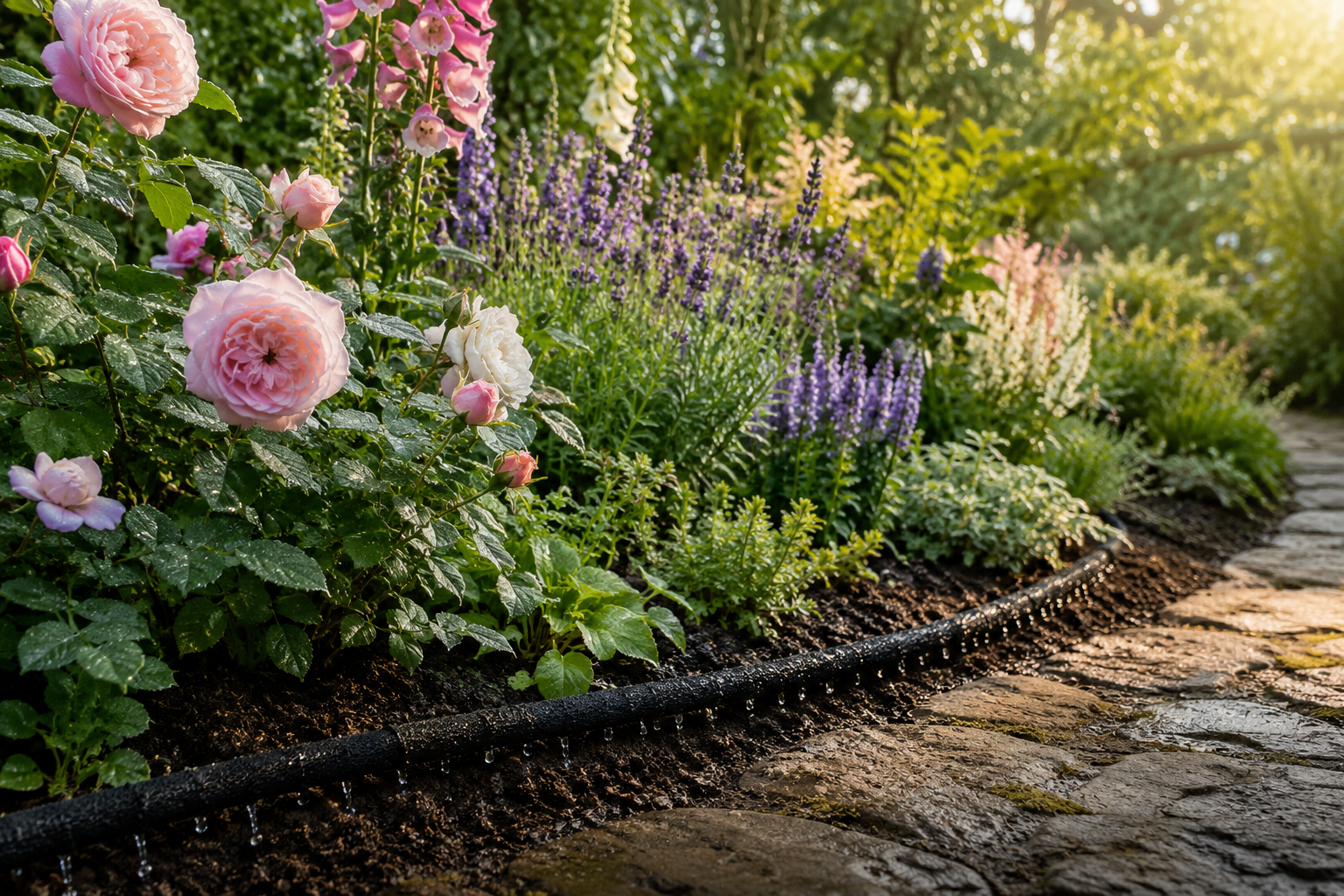
Keeping a flower bed evenly moist sounds simple until summer arrives.
Hand watering takes time, overhead sprinklers wet leaves and paths, and
a conventional hose can deliver too much water in one place. A good
soaker hose solves those problems by releasing water slowly along the
soil surface, close to the plants that need it.
The best soaker hose for flower beds should match the shape and size
of the planting area. Flat hoses store neatly and work particularly well
along straight borders. Round hoses tend to hold their shape and curve
naturally around roses, shrubs and informal cottage-garden beds. Larger
gardens may benefit from several shorter linkable sections rather than
one extremely long run.
This guide compares seven useful options for different garden layouts
and budgets. It also explains how to choose the right length, regulate
pressure and install a soaker hose without wasting water.
Affiliate disclosure: This post contains affiliate
links. As an Amazon Associate, Tendrelia earns from qualifying purchases
at no additional cost to you.
The best soaker hoses at a
glance
| Product | Best for | Length reviewed | Style | Main advantage |
|---|---|---|---|---|
| LINEX Flat Soaker Hose | Best overall | 50 ft | Flat | Practical balance of length, storage and value |
| Rocky Mountain Goods Soaker Hose | Curved cottage borders | 50 ft | Round rubber | Flexible placement around established plants |
| Gilmour Flat Weeper Soaker Hose | Long straight beds | 75 ft | Flat | Covers a longer border with one hose |
| Secbulk Linkable Soaker Hose System | Large beds and multiple zones | 200 ft total | Four flat sections | Divides a large garden into manageable runs |
| Water Right Polyurethane Soaker Hose | Premium small beds | 25 ft | Round polyurethane | Compact, unobtrusive premium construction |
| Melnor Soaker Hose | Easy storage | 50 ft | Flat | Lightweight and simple to coil away |
| Teknor Apex Soil Soaker | Heavy-duty round option | 50 ft | Round vinyl | Substantial 5/8-inch hose with threaded coupling |
1. LINEX 50-Foot
Flat Soaker Hose — Best Overall
The LINEX 50-foot flat soaker
hose is the strongest all-around choice for a typical home flower
border. Its 50-foot length is useful without becoming difficult to
position, and the flat format is easy to roll up when the growing season
ends.
This hose makes the most sense in rectangular beds, along the front
of a cottage border or in a row of roses where the route is reasonably
direct. It can bend around gentle corners, although gardeners with
tightly curved beds may prefer a round hose.
The appeal of the LINEX is its balance. It is long enough for many
established borders, compact enough to store and widely reviewed by
Amazon shoppers. Stakes can help keep a flat hose from shifting while it
fills and empties.
Best for: Gardeners who want one versatile hose for
a medium-size flower bed.
Advantages
- Convenient 50-foot length
- Flat design stores compactly
- Suitable for flower beds, rose rows and raised beds
- Can be connected to compatible sections when needed
Consider before buying: Flat hoses should be laid
without twists or sharp folds. Unroll the hose fully before turning on
the water.
2.
Rocky Mountain Goods 50-Foot Soaker Hose — Best for Curved Cottage
Borders
Informal cottage gardens rarely follow straight lines. The Rocky Mountain Goods 50-foot rubber
soaker hose is a better fit when the watering route needs to sweep
around roses, perennials and small shrubs.
Its round construction is easier to arrange in broad curves than many
flat hoses. That makes it useful for island beds, circular plantings and
borders with mature plants already occupying most of the soil surface.
Reinforced fittings and a removable end cap also allow another
compatible hose to be connected where the water pressure and
manufacturer guidance permit.
Position the hose several inches away from crowns and woody stems
rather than pressing it directly against them. The goal is to moisten
the active root zone, not keep the plant’s base constantly wet.
Best for: Curving beds and naturalistic
cottage-garden layouts.
Advantages
- Round rubber form follows curves well
- 50-foot length suits many mixed borders
- End connection supports flexible layouts
- Useful around roses and established perennials
Consider before buying: A round rubber hose occupies
more storage space than a flat model and can be heavier to
reposition.

3.
Gilmour 75-Foot Flat Weeper Soaker Hose — Best Value for Long Straight
Beds
The Gilmour 75-foot flat weeper
hose provides additional reach for long foundation beds, fence-line
borders and straight rows of flowers. Using one 75-foot section can be
simpler than joining multiple short hoses, particularly when the bed is
level.
Longer is not always better, however. Water pressure drops as it
travels through a porous hose, so the far end of a long run may release
less water than the beginning. This is more noticeable on sloping ground
or with low household pressure. A pressure regulator and a level layout
can improve consistency, but splitting a difficult bed into shorter
zones is often the better solution.
Use a simple moisture test during the first few runs. Check the soil
near the beginning, middle and end of the hose. If moisture varies
considerably, shorten the run or water the sections separately.
Best for: Long, mostly level and relatively straight
flower borders.
Advantages
- Longer 75-foot coverage
- Flat profile can sit beneath a light mulch layer
- Rolls compactly for storage
- Useful along fences and foundation beds
Consider before buying: Do not assume that a longer
hose will water every layout evenly. Test all sections of the bed.
4.
Secbulk 200-Foot Linkable Flat Soaker Hose System — Best for Large Beds
and Multiple Zones
The Secbulk 200-foot linkable
soaker hose system is supplied as four 50-foot sections with stakes.
That segmented format is more valuable than simply owning one very long
hose: each section can serve a separate bed or watering zone.
It is a useful arrangement for a larger cottage garden with a front
border, rose bed, cutting garden and raised bed. Instead of forcing
water through a single 200-foot porous run, the gardener can operate
shorter sections individually. This makes it easier to adapt watering
time to different plants and soil conditions.
The included stakes help hold the lightweight flat hoses in position.
Map the zones before installation and group plants with broadly similar
moisture needs. Drought-tolerant lavender should not automatically
receive the same schedule as moisture-loving annuals simply because they
share a garden.
Best for: Large gardens containing several distinct
beds.
Advantages
- Four separate 50-foot hoses
- Stakes included for positioning
- Easier to create independent watering zones
- Provides extensive total coverage
Consider before buying: Avoid operating all 200 feet
as one uninterrupted run unless the instructions and available pressure
support it. Shorter zones generally make monitoring easier.

5.
Water Right 25-Foot Polyurethane Soaker Hose — Best Premium Option for
Small Flower Beds
The Water Right 25-foot
polyurethane soaker hose is a compact premium choice for a small,
visible flower bed. The pine-straw color is less visually intrusive than
a black hose when it cannot be completely hidden by foliage or
mulch.
At 25 feet, it is well suited to a courtyard border, a small rose bed
or the planting around a porch. Short runs can also deliver more
consistent results than a single long hose, particularly when the water
source has modest pressure.
This is not the economical choice for covering an expansive garden.
Its value lies in manageable length, discreet appearance and
polyurethane construction. Availability should be checked again
immediately before publication because the listing showed limited stock
during research.
Best for: A small decorative bed where appearance
and manageable length matter.
Advantages
- Compact 25-foot run
- Neutral pine-straw color
- Flexible round construction
- Well suited to courtyards and small rose beds
Consider before buying: The cost per foot is higher
than the flat-hose options, and it is not intended to cover a large
landscape economically.
6. Melnor
50-Foot Soaker Hose — Best for Easy Storage
The Melnor 50-foot soaker hose
is a straightforward flat hose for gardeners who want something
lightweight and easy to put away. It lies flat when empty, so it takes
up less shed or garage space than a thick round hose.
Its brown-green coloring can blend more naturally with soil and mulch
than a stark black line. The hose is a practical fit for seasonal flower
beds where the watering arrangement is removed before winter or
repositioned as annual plantings change.
As with every flat hose, careful setup matters. Lay it out while
empty, smooth out twists and secure broad turns with landscape staples
or compatible hose stakes. Do not pull it tightly around plant
stems.
Best for: Seasonal beds and gardeners with limited
storage space.
Advantages
- Flat, compact storage
- Useful 50-foot length
- Earth-toned appearance
- Easy to move between seasonal beds
Consider before buying: Flat fabric-style hoses can
kink if routed through tight corners. Create gradual curves instead.
7.
Teknor Apex 50-Foot Soil Soaker — Best Heavy-Duty Round Soaker Hose
The Teknor Apex 50-foot Soil
Soaker is a substantial round option with a 5/8-inch diameter and
threaded metal coupling. It is a good alternative for gardeners who
dislike the way flat hoses collapse, twist or move during setup.
Its round body suits permanent or semi-permanent routes through
flower and vegetable beds. The hose can be arranged in gentle curves and
covered with a shallow layer of mulch after its watering pattern has
been tested.
The product is marketed for both soaking and misting, so placement
and pressure are especially important. For flower-bed irrigation, keep
the perforated surface oriented to release water toward the soil and use
only enough pressure to produce slow seepage. Spraying or jets indicate
that the pressure is too high or the orientation needs adjustment.
Best for: Gardeners wanting a robust round hose with
a conventional threaded coupling.
Advantages
- Round 5/8-inch construction
- 50-foot coverage
- Metal threaded coupling
- Works through gently curved mixed beds
Consider before buying: The listing was sold by a
third-party marketplace seller during research, so reconfirm seller,
availability and return terms before purchase.
Flat versus round soaker
hoses
Neither format is universally superior. The right choice depends on
the bed.
Choose a flat soaker hose
when:
- The border is straight or rectangular.
- Compact winter storage is important.
- You want a lightweight hose that can sit beneath mulch.
- The layout changes from season to season.
Choose a round soaker hose
when:
- The border contains broad curves.
- The hose will stay installed for most of the growing season.
- You want a hose that maintains its shape when empty.
- The route winds around established roses, shrubs or perennials.
Flat hoses usually cost less and store easily, but they must be kept
free of folds. Round hoses are bulkier yet often easier to arrange
through an informal planting.
How long should a soaker hose
be?
Measure the actual route through the bed instead of using only its
outside dimensions. Add enough length to reach the water source, but
avoid buying excessive porous hose “just in case.”
For many home beds, 25 to 50 feet is a manageable watering zone. A
75-foot hose can work in a level straight border, but it deserves
careful testing. Very large gardens are usually easier to manage with
several independently controlled sections.
If one bed contains plants with different water needs, divide it into
hydrozones. Roses and thirsty annuals can share one section, while
established drought-tolerant plants can receive a different
schedule.
Pressure, flow and
essential accessories
Soaker hoses are designed to seep, not spray. Fully opening the
outdoor faucet can create uneven watering, split connections and waste
water.
A practical setup may include:
- A backflow preventer where required by local rules
- A timer for consistent operation
- A low-pressure regulator compatible with the hose manufacturer’s
recommendation - A filter if sediment is likely to clog the hose
- A short non-porous leader hose between the faucet and flower
bed - Stakes or landscape staples to hold the route
Start with low flow. Increase it gradually until the hose sweats or
weeps along its length. If water shoots upward, reduce the pressure.
How to install a
soaker hose in a flower bed
- Plan the route. Keep the hose near the root zones
without pressing it against stems, crowns or trunks. - Level the layout when possible. Significant
elevation changes can produce uneven output. - Unroll the hose completely. Remove twists and
create broad curves rather than sharp corners. - Flush before final placement. Follow the
manufacturer’s directions and clear debris from the line. - Connect appropriate accessories. Install the
filter, regulator, timer and leader hose if required. - Run a short test. Look for dry sections, spraying,
leaks and loose couplings. - Check the soil. Test moisture at the beginning,
middle and end of the run. - Secure the hose. Add stakes only after the watering
pattern is satisfactory. - Cover lightly with mulch. A shallow layer can hide
the hose and reduce evaporation, but do not bury it deeply unless the
manufacturer explicitly permits that use.

For a complete setup walkthrough, see our guide to how to use a soaker hose in flower beds, including layout, timing and pressure.
How long should you run a
soaker hose?
There is no reliable universal runtime. Hose output, water pressure,
soil texture, temperature, rainfall, mulch and plant maturity all affect
the answer.
Begin with a trial run of approximately 20 to 30 minutes, then wait
briefly and inspect the soil several inches below the surface. Adjust
the next session based on how deeply and evenly the water moved. Sandy
soil drains quickly and may need shorter, more frequent sessions. Clay
soil absorbs slowly and may require a lower flow or split watering cycle
to prevent pooling.
Established plants generally benefit from deeper, less frequent
watering rather than daily surface wetting. Newly planted flowers need
closer monitoring until their roots spread into the surrounding soil.
Early morning is usually a convenient time to irrigate because
evaporation is lower and any accidentally wetted foliage can dry as the
day warms.
Common soaker-hose mistakes
Using too much pressure
Spraying is not faster soaking. It reduces control and can damage the
hose. Use low pressure and follow the product instructions.
Creating one excessively long
run
The beginning may receive more water than the far end. Divide large
gardens into shorter zones.
Mixing plants with very
different needs
One watering schedule cannot suit every plant. Group compatible
plants wherever possible.
Setting a timer and
never checking the soil
Weather changes. Reduce irrigation after rain and increase monitoring
during heat or wind. A timer provides consistency, not judgment.
Placing the hose against
plant crowns
Continuous moisture around crowns and woody stems can invite
problems. Water the surrounding root zone instead.
Hiding the hose before
testing it
Run and inspect the complete system first. Once the pattern is
correct, cover it lightly with mulch.
Frequently asked questions
Are soaker hoses good for
flower beds?
Yes. They deliver water near the soil and roots while reducing
unnecessary wetting of foliage and paths. They are especially useful in
densely planted borders where overhead watering is awkward.
Can I use a soaker hose
around roses?
Yes. Route it through the rose root zone, not tightly against the
canes or crown. For more seasonal guidance, see our guide to pruning
climbing roses.
Should a soaker
hose go above or below mulch?
Place it on the soil surface and, after testing, cover it with a
light layer of mulch. This makes inspection and seasonal maintenance
easier than deep burial.
Can several soaker hoses
be connected?
Some models are linkable, but the practical total length depends on
pressure, elevation and the manufacturer’s limits. Multiple shorter
zones usually provide better control than one extremely long porous
line.
Do I need a pressure
regulator?
It is often helpful because soaker hoses operate at low pressure.
Follow the hose manufacturer’s stated requirements and use compatible
fittings.
How close should the
hose be to plants?
Place it where water can reach the active roots while leaving space
around crowns and stems. Exact spacing depends on plant size and soil
type, so verify moisture below the surface.
Can a soaker hose be
left out all year?
That depends on the material and climate. Drain and store removable
hoses before freezing weather unless the manufacturer specifically
approves another winterization method.
Is a 50-foot or 100-foot
hose better?
For most flower beds, a 50-foot zone is easier to monitor. A 100-foot
run may be appropriate in a suitable level layout, but two independently
controlled 50-foot sections often provide more even and adaptable
watering.
What is the
best soaker hose for a cottage garden?
The LINEX is the best general-purpose choice in this comparison.
Choose Rocky Mountain Goods for sweeping curved borders, Secbulk for
multiple large zones, or Water Right for a compact premium bed.
Final verdict
The LINEX 50-foot flat soaker
hose is our best overall choice because its length and flat design
suit many ordinary flower beds. The Rocky Mountain Goods round hose is
more natural in curved cottage borders, while the Secbulk four-section system offers
the most flexible coverage for a large garden.
Choose according to the bed rather than the longest specification. A
correctly positioned 25- or 50-foot hose operated at low pressure will
often water more effectively than a complicated oversized run. Test the
soil, divide the garden into sensible zones and adjust the schedule as
weather and plants change.
For beds containing climbing roses, combine efficient watering with a
stable support. Our comparisons of garden
arches for climbing roses, garden
trellises for climbing plants and climbing
roses for arches, pergolas and trellises can help complete the
planting design.
Leave a Reply