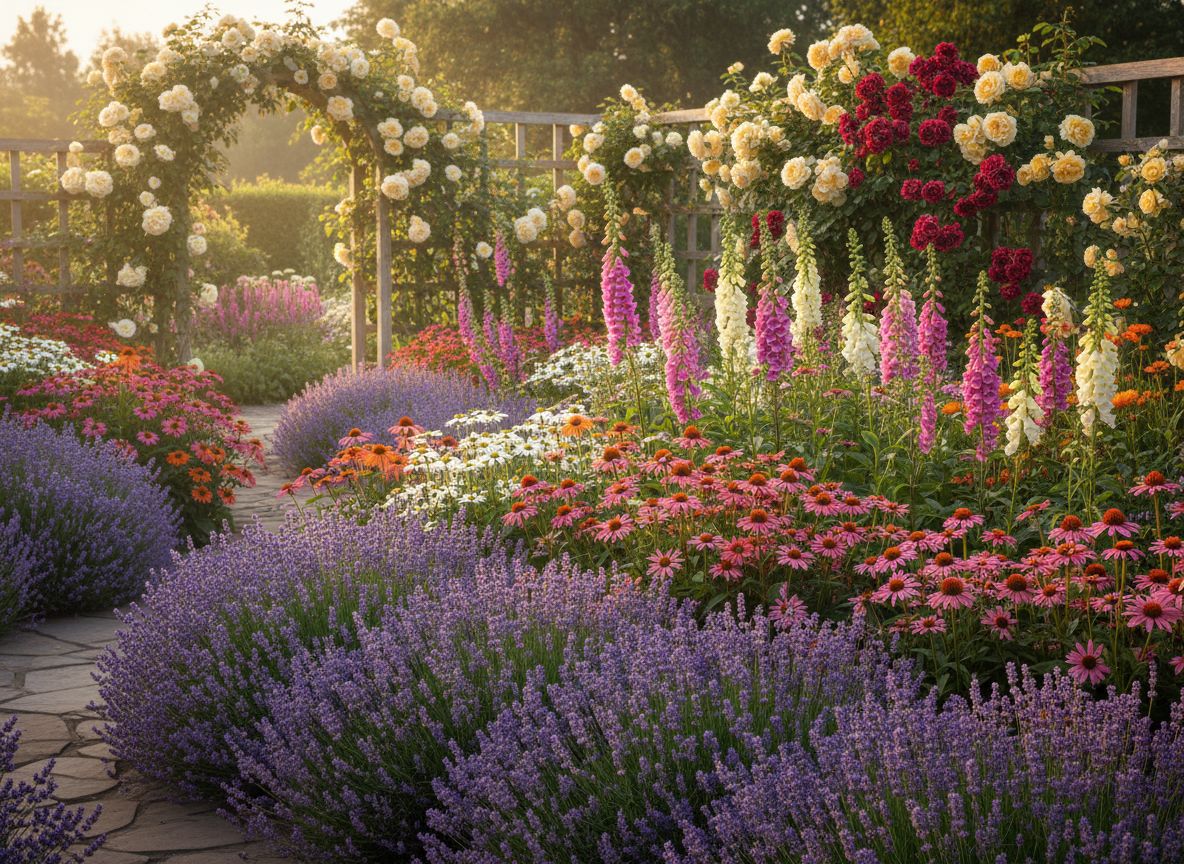
Perennials are one of the easiest ways to give a cottage garden continuity. They return for multiple seasons, knit borders together, and make it possible to build colour and texture gradually rather than replanting the entire garden each year.
Jump to: Sun-loving perennials · Classic border perennials · Plant combinations · Border care
There is no single list of “best” perennials for every garden. Climate, winter cold, summer heat, rainfall, soil, and light all matter. The plants below are useful cottage-garden starting points where conditions suit them, but always check local hardiness, water needs, and invasive-plant guidance before planting. If native soil or drainage makes perennial planting difficult, see our comparison of raised garden beds for flowers and cottage gardens.
What makes a good cottage-garden perennial?
- It suits your site rather than needing constant rescue.
- It offers useful colour, foliage, texture, or seed heads.
- It combines easily with neighbouring plants.
- It has a mature size that fits the border.
- It contributes at a different time from some of your other plants.
Keep your plant ideas together: Subscribe to receive our free Cottage Garden Seasonal Planner by email. Use the planting wishlist to shortlist perennials suited to your garden, and the garden notes to record flowering times and seasonal observations.
Sun-Loving Cottage Garden Perennials
1. Lavender
Lavender brings fragrance, evergreen or semi-evergreen structure in suitable climates, and the soft purple colour strongly associated with romantic garden borders. It generally prefers plenty of sun and sharply drained soil and often struggles in persistently wet ground.
2. Catmint (Nepeta)
Catmint is valuable for its soft habit and long haze of blue-violet flowers. It works especially well along path edges or around roses and taller perennials, where its loose form helps soften harder lines.
3. Salvia
Perennial salvias add vertical flower spikes and strong colour without taking up excessive visual space. Many selections flower again after trimming, although performance varies by species and climate.
4. Yarrow (Achillea)
Yarrow contributes flat flower heads, ferny foliage, and a relaxed meadow-like quality. It is particularly useful for adding a different flower shape among spikes and daisies.
5. Coneflower (Echinacea)
Coneflowers provide bold daisy-like blooms and strong seed heads that can extend the border’s interest after flowering. They combine especially well with grasses, salvias, and other late-season perennials.
6. Black-Eyed Susan (Rudbeckia)
Rudbeckia adds warm late-season colour and a cheerful naturalistic look. Use it where its growing conditions are suitable and where its stronger yellow or gold tones fit the palette you want.
Classic Border Perennials for Layering
7. Hardy Geranium
Hardy geraniums are excellent gap-fillers. Their mounding habit helps cover bare soil, soften edges, and weave between more upright plants without dominating the whole border.
8. Garden Phlox
Where summers and disease pressure allow it, garden phlox provides tall clusters of flowers and traditional cottage-border presence. Good airflow and choosing well-adapted cultivars can be important.
9. Peony
Peonies offer a dramatic early-season flowering moment and handsome foliage afterward. They can be long-lived when planted in conditions that suit them, but they are not appropriate for every climate and generally prefer to remain undisturbed once established.
10. Campanula
Bellflowers range from low edging plants to taller border forms. Their bells bring a delicate shape that sits beautifully beside roses, geraniums, and other traditional cottage-garden plants.
11. Dianthus
Many perennial dianthus varieties stay relatively compact and add fragrance, fine foliage, and low-growing flowers to sunny edges. They generally appreciate good drainage.
12. Stonecrop (Hylotelephium/Sedum types)
Upright stonecrops are useful for later-season interest, sturdy flower heads, and architectural shape. Their succulent foliage also creates welcome contrast beside softer-leaved plants.
How to Combine Perennials Without Making the Border Feel Busy
A cottage border can contain many species and still feel calm if you repeat a few key plants and limit the number of competing ideas in each section.
- Repeat one soft filler: for example, hardy geranium or catmint.
- Add vertical accents: such as salvias or another locally suitable spike-forming perennial.
- Add a contrasting flower shape: flat yarrow heads or daisy forms like echinacea can break up too many spikes.
- Use foliage as part of the design: leaf size, colour, and texture matter between flowering periods.
- Stagger bloom times: avoid choosing everything for the same three-week peak.
Three Easy Cottage-Garden Colour Directions
Soft & Romantic
Lavender, soft pink, white, blue, and silvery foliage.
Warm & Sunny
Apricot, yellow, terracotta, dusky pink, and fresh green.
Cool & Calm
Blue, violet, white, deep plum, and restrained green foliage.
Keeping a Perennial Border Looking Good
- Space plants according to mature size rather than nursery-pot size.
- Water new plantings consistently while they establish according to local conditions.
- Mulch where appropriate to reduce weeds and moisture loss.
- Cut back, deadhead, or leave seed heads according to the plant, climate, and look you want.
- Divide overcrowded perennials when the species benefits from division.
- Remove plants that repeatedly struggle and replace them with something better suited to the site.
Watering tip: Dense perennial borders are easier to irrigate at soil level. Our comparison of the best soaker hoses for flower beds explains suitable lengths, layouts and watering zones.
The strongest cottage gardens are not built from a universal shopping list. They come from observing what thrives, repeating successful combinations, and letting the planting become more confident over time.
When it is time to plant, compare our best garden tools for cottage-garden beginners. If you are weaving spring bulbs between established perennials, our guide to the best bulb planters can help you choose a tool suited to repeated planting.
Plan Your Cottage Border
Chosen your perennials? Use our three-layer border guide to arrange taller anchors, repeated middle groups and low edging plants into a practical planting plan.
Responses
[…] dependable middle-layer ideas, explore our guide to the best perennials for a cottage garden. Choose varieties suited to your climate and growing conditions rather than copying a fixed plant […]
[…] and medium-height phlox are examples, but suitability depends on the site. See our guide to the best perennials for a beautiful cottage garden for more […]
[…] because cooler conditions reduce stress and there may still be time for roots to establish. Use our best perennials for a beautiful cottage garden as a reminder of mature size before replanting […]
[…] in selected areas. The permanent structure can still come from shrubs, roses, bulbs and the best perennials for a beautiful cottage garden; seed-grown flowers provide the flexible layer between […]
[…] a long season, weave bulbs around the best perennials for a beautiful cottage garden. Emerging perennial foliage can gradually soften the fading bulb leaves without hiding the spring […]
[…] blooms and let compact plants lean slightly over the edge. For plant ideas, see our guides to the best cottage garden perennials and easy cottage garden flowers from […]